 Danielle Sullivan
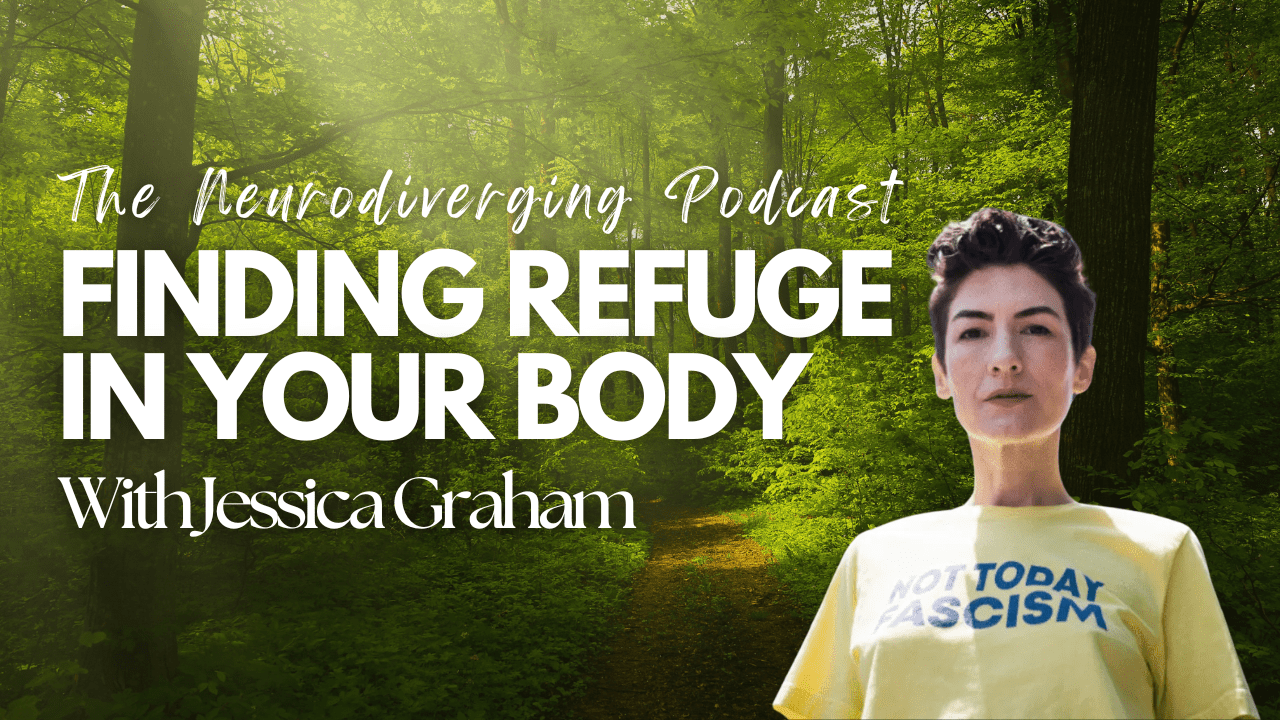
In this episode of the Neurodivergent Podcast, host Danielle Sullivan chats with Jessica Graham, a writer, meditation teacher, actor, and trauma-informed guide.
Jessica discusses their new book, Being (Sick) Enough, which delves into living with chronic illness, neurodivergence, and childhood trauma. Topics include the healing power of meditation, the intersection of trauma and neurodivergence, and embracing pleasure.
This conversation is a valuable resource for anyone navigating similar challenges or seeking to live authentically with neurodivergence and chronic illness.
Contents
- 1 Show Notes:
- 2 Guest Bio: Jessica Graham
- 3 About Neurodiverging
- 4 Transcript: Finding Refuge in Your Body with Jessica Graham
- 5 Welcome and Guest Introduction
- 6 Thanks to Patrons & Where to Find Resources
- 7 The Focus of Our Conversation Today
- 8 Welcome and an Authentic Answer to “How Are You Doing?
- 9 Jessica’s Inspiration for Their Book
- 10 The Meaningful Intersection of Neurodivergence, Chronic Illness, and Trauma
- 11 Reconstruction of Self
- 12 There are Multiple Ways to Meditate
- 13 Meditation Can Be Uncomfortable
- 14 Resource Practice
- 15 Jessica’s Thoughts on Mindfulness
- 16 The Side Effects of Meditation
- 17 You Do Not Have to “Quiet Your Mind”
- 18 Pleasure as Healing
- 19 Pleasure is Practice
- 20 Jessica’s Upcoming Plans
- 21 Outro & Thanks
Listen on Apple Podcasts | Spotify | Youtube
Thank you to our Patrons for funding this podcast. Find out more and pledge today at patreon.com/neurodiverging.
Show Notes:
- Get ad-free podcast downloads and lots more: http://patreon.com/neurodiverging
- Check out the Wild Awakening Collective: https://yourwildawakening.com/
- Jessica Graham’s Substack: https://jessicagraham.substack.com/?r=3bv9lk
- Buy Jessica’s books:
- Good Sex: Getting Off without Checking Out
- on Amazon: https://amzn.to/3VQiuFC
- Bookshop: https://bookshop.org/a/4824/9781623172343
- Being (Sick) Enough: Thoughts on Invisible Illness, Childhood Trauma, and Living Well When Surviving Is Hard
- on Amazon: https://amzn.to/3IXwdaG
- Bookshop: https://bookshop.org/a/4824/9798889840008
- Good Sex: Getting Off without Checking Out
Guest Bio: Jessica Graham

Jessica Graham is a trauma resolution guide, specializing in complex-developmental trauma and post-traumatic growth. They are also a meditation teacher, chronic pain coach, sex and relationship guide, speaker, and author of Good Sex: Getting Off Without Checking Out and Being (Sick) Enough: Thoughts on Invisible Illness, Childhood Trauma, and Living Well When Surviving Is Hard. Jessica is certified as both a ReBloom Post-Traumatic Growth Guide and a Grief Recovery Specialist. They have been trained and are qualified to practice in Brainspotting and are a senior teacher of Shinzen Young’s meditation system. Jessica’s work can be found on many apps, and they have offered workshops and retreats at various centers internationally, including Esalen Institute. Their work can also be found in The Great Courses’ Masters of Mindfulness. In addition to this, Jessica is an acting teacher and an award-winning actor and filmmaker.
About Neurodiverging
Neurodiverging is dedicated to helping neurodiverse folk find the resources we need to live better lives as individuals, and to further disability awareness and social justice efforts to improve all our lives as part of the larger, world community. If you’re interested in learning more, you can:
- Join our mailing list to make sure you are notified when there’s a new episode!
- Take a look around at previous podcast episodes, blog posts, and coaching offerings here on neurodiverging.com.
- Looking for something specific or have a question? Send us an email at contact@neurodiverging.com.
- Check us out on Patreon to support this podcast and blog!
Transcript: Finding Refuge in Your Body with Jessica Graham
Jessica Graham: No matter what’s going on, no matter how much physical, emotional, mental pain you might be in, you can find some refuge in your own body, which is pretty rad when it comes to complex trauma, neurodivergence and chronic illness and pain.
Welcome and Guest Introduction
Danielle Sullivan: Hi, wonderful humans, and welcome back to the Neurodiverging Podcast. My name’s Danielle Sullivan. I am your host today. As always, I’m extremely happy to be here. Today we have an amazing guest. Someone whose work invites us to slow down and feel deeply and tell the truth about our bodies and our minds, and our desires, and especially when those things don’t fit the mold.
Jessica Graham is a writer, a meditation teacher, an actor, and a trauma-informed guide. Their new book, Being Sick, is a beautiful raw exploration of what it means to live inside a body that is chronically ill, neurodivergent, shaped by childhood trauma, while also being very alive and sensual, and sacred, and the book is deeply layered about grief, survival, sex, consent, illness, and the process of becoming. I was offered a copy of the book by Jessica’s team and read it so quickly over like two days, and knew that I had to get them on the show. I’m really excited that they’re here with us today.
Thanks to Patrons & Where to Find Resources
I do, of course, want to thank our patrons over at patreon.com/neurodiverging for supporting this podcast and with it all of our low-income sliding scale folks who get coaching services through any funds created from this podcast over at Neurodiverging Coaching.
If you are interested in becoming a patron, you can access a huge range of webinars, classes, guides, reflective practices, meditations, and other things by going to patreon.com/neurodiverging. You can also learn more about our sliding scale coaching for all kinds of neurodivergent folks over at neurodiverging.com. Thank you to the patrons for making this possible.
The Focus of Our Conversation Today
Danielle Sullivan: Jessica and I had a ranging conversation. I would’ve liked it to have gone on for much longer, you know. I felt like this book had so much to tell us. We are here talking today about what it means to live with grief as a companion, and how neurodivergence shapes embodiment, and some of the dimensions of being chronically sick in the world. It’s a really good listen, and I hope you’ll enjoy it.
Welcome and an Authentic Answer to “How Are You Doing?
Welcome so much to the podcast, Jess. I’m really excited to talk about your book today. How are you doing?
Jessica Graham: How am I? That’s quite—
Danielle Sullivan: It’s a, it’s an opening.
Jessica Graham: I don’t ever answer that question inauthentically anymore.
Danielle Sullivan: Mm-hmm.
Jessica Graham: So how am I doing is, it’s been a, it’s been a, a tough period. I got pretty sick in July of 2024 and haven’t really been able to get past a certain level of recovery. And it’s been a while. It’s been a good number of years since I’ve been sick for this long.
Danielle Sullivan: Yeah.
Jessican Graham: In this way. So, yeah, I’ve, there’s been a lot of financial surprises as a result, and it’s been an intense time and a really beautiful time of being basically forced to ask for help and to get help from my community and to get help from family and friends and in a lot of different ways. And as much as it can be uncomfortable, I know at this point to trust that it is a process that will yield beautiful results.
Whenever I go through one of these times on whatever, whatever level it is, illness or mental health or whatever, on the other side, there’s more love and there’s more peace, and there’s more joy of the unconditional nature, and there’s more connection to what actually has meaning and what, yeah, what actually matters to me. And so yeah, on a personal level, things have been tough. And then obviously on a global level, things have been tough.
And I am, I’ve always been very aware of that since I was a little kid and like in the Reagan era, and so I am feeling it. Luckily, I have lots of tools to like, not necessarily take it on, into my body, into my nervous system, but certainly I’m not doing that perfectly. So it does, it certainly affects me, and I think it affects us all, whether we know it or not.
Danielle Sullivan: Yeah. I don’t think that even with all the tools in the universe, however many that is ’cause there are so many tools that can be supportive during a political time like this. And even with all those tools, I think it would be impossible to be unaffected by what’s going on. I, I liked what you just said about how, or what I heard anyway, that the discomfort of going through a process, like asking for help from the community and opening up that vulnerability.
When I was reading your book a—it’s a collection of essays, and initially I was in my brain trying to figure out, okay, how’s this essay connected to this one? Connected to this one? And over time, one of my takeaways was that it was in many ways about the processes of not just like the takeaway of, “I went through this thing and I learned X,” but the exploration and that the depth of the experience of grief, the experience of good sex, the experience of illness. I, I really appreciated that and love that, and I’m hoping to talk to you a little bit about it today.
One thing I wanted to ask, though, is the book I believe just came out a couple of—It’s, what is it? It’s May 2025 as we’re recording. It came out in January. Is that true?
Jessica Graham: It did. Right, right in the midst of the LA fires, and I live here.
Danielle Sullivan: Wow.
Jessica Graham: So it was, it was a little bit of a wild time. Yeah.
Jessica’s Inspiration for Their Book
Danielle Sullivan: Gosh, that’s a hard, that’s a hard time. I wanted to ask what encouraged you, or caused you to write this now and put it out into the universe now? You’ve done so many, I know you’ve done other books. You’ve done film, you’ve done theatre, you’ve done so many different kinds of communications, it seems like over the course of your life. What called you to this project in, in this time?
Jessica Graham: A lot of it had to do with just being ready. In order to write this and put it out, I needed to cross a number of thresholds that I had been hanging out at the edge of for quite a while. It’s also, from all the years now of working with clients one-on-one and seeing trauma, specifically complex developmental trauma, the effects of complex post-traumatic stress conditions, how they intersect with neurodivergence, how they intersect with obviously mental health, but uh, physical health. And for some spiritual health for, for those that you know are comfortable with that word. And I was working with folks and seeing all kinds of experiences, all kinds of human experiences, and also the resilience and the beauty of post-traumatic growth.
And so between my own lived experience and then really just witnessing and having the honor and the privilege of supporting folks through that process of trauma resolution and working with chronic illness and working with neurodivergence, I felt really called to share, you know, on a larger scale because not everybody is gonna—this book’s not for everyone. Not everyone will like it. Some people it might be for, but it’s just too much. Like I definitely. I have people close to me that are like, “I’m sorry, I can’t read it.”
Danielle Sullivan: Mm-hmm.
Jessica Graham: Um, it’s, there’s, it’s, there’s just too, too much to navigate as far as what comes up while reading it. But for the folks that it is for and for the folks that it is the right time for, I’ve been getting feedback that it’s offering that sense of not being alone.
Danielle Sullivan: Mm-hmm.
Jessica Graham: And of possibility of potentiality, and that is kind of the point. So like to be—if I can do that for one person, that’s amazing. If I can do that for more, then that’s cherries on top.
Danielle Sullivan: Yeah, I, I saw a, I think, I think it was on Goodreads. Uh, I’ll have to double-check that. I saw a review that called it, “Brutally Honest”, and I liked that because you discuss some really hard things. Relationships that didn’t work. Um, trauma and, and abuse, we could list it, but you also, the way you approach everything was so frank and honest and clearheaded. And I think from the lens of having done so much work and having thought through it, that the honesty was so, so refreshing for me. And that might be also in, in the sense of it didn’t feel like you were just looking for the takeaway that you could sort of give out to audiences.
The Meaningful Intersection of Neurodivergence, Chronic Illness, and Trauma
Danielle Sullivan: One of the things I wanted to ask you about is you talk, I guess it’s sort of midway through, you talk about being diagnosed autistic and ADHD, and you talk about sensory overwhelm and hyperfocus, and I wondered if we could speak briefly to how naming those things, those neurodivergences—if it shifted your understanding of your ill, your chronic illness and, and trauma in meaningful ways.
My question is also because I have a lot of clients who come in, um, neurodivergent and sort of, it was the opposite, that they’re, they know they’re neurodivergent, but they’re just realizing that maybe PTSD or similar applies to them. And I’m very interested, I guess, in the intersection of those identities.
Jessica Graham: So when I got diagnosed with A DHD, I was not looking for that diagnosis. I mean, not that, I don’t mean I wasn’t looking for it, as in, “I didn’t, no, stay away.” It was more like I wasn’t seeking that out. Like it wasn’t like, “oh, I think I might be ADHD.” Um, some of that was because I just had some level of judgment as far as myself, like, it’s okay for others, but not for me because I’m a meditation teacher because blah, blah, blah, because blah, blah, blah. I could go to a meditation retreat and meditate for like 16 hours a day. How could I possibly—
Danielle Sullivan: Yeah.
Jessica Graham: Oh, oh, that’s hyperfocus. Oh, that’s special interest. But didn’t know that at the time. Um, what I was looking for at the time was help with the extreme fatigue and complete lack of any kind of motivation that I was feeling.
Now, I had done a ton of trauma work at that point. I was already doing trauma work with others in a official manner. I had been through some training and certifications and things, and I was like, what if, what if this fatigue and this lack of motivation isn’t the chronic illness, isn’t the trauma. What if there’s something else going on here that I need psychiatric help with?
And I hadn’t had a great experience with psychiatry when I was younger. I’d had just a brief stint, and I was like, “Nope, not doing that.” Um. I had had some unfortunate experiences with antidepressants that I was prescribed for pain management, that did help with pain, but they also did some other things, and that was me. I know some people they can take them, and it’s like life-changing. For me, life-changing, but not in the best way. So I was it, I was a little hesitant, but I was just like, you know what? It can’t go on like this, like this fatigue, this just like slump all the time. So I went and and saw ultimately a psychiatric nurse practitioner, which I do tend to recommend to my clients because you usually get more time, and you get more attention, and you get more focus unless you’re paying like hundreds and hundreds and hundreds of dollars to like a top-notch psychiatrist.
I was already prescribed Wellbutrin, which I love, and I loved because it wasn’t an SSRI or an SNRI and it for the first couple of weeks that I was on it, the fatigue lifted, the fog lifted. I felt motivated, and I was like, Wow, okay, cool. But then that faded it, it still did, had some benefits, but it faded. So we’re just, you know, I’m talking with this practitioner and going over my symptoms and after maybe about three or four sessions with him, he’s like, have you ever tried a stimulant? And I’m like. You mean recreationally, or you know, like, like as a teenager, I was like snorting Ritalin and then being like, why do I feel like normal and great?
Danielle Sullivan: Yeah.
Jessica Graham: Or like I started drinking coffee at like six years old, and I was always like, oh, it was because I was rebelling against my mother, who said you couldn’t have caffeine and it would stunt your growth or something. But I was just trying to feel normal.
Danielle Sullivan: Yeah.
Jessica Graham: It’s also why I like loved cocaine, but avoided it because I was like, I’ll just stick with being a teenage alcoholic. I don’t also need to have the cocaine addiction. So I rarely would use it. But when I did, I was like, oh, this feels great.
Danielle Sullivan: Yeah.
Jessica Graham: Like, and not just like the being on drugs, but in the like, oh, I feel like, hmm, maybe normal. I don’t know. Not, I’m not, you know, I’m not promoting these drugs. I’m just saying that was, that was my experience.
Danielle Sullivan: Yeah. They, they can, they can have a, a negative health result and also a positive experience, you know?
Jessica Graham: Yeah, totally. And you know, I mean, for me, alcohol saved my life.
Danielle Sullivan: Yeah.
Jessica Graham: If I hadn’t been a teenage alcoholic, I’d be dead for sure. I mean, I, I really would, I wouldn’t have made it, I wouldn’t have been able to stay alive. It was, there was just too much going on.
But in any case, it was like, he said, let’s, let’s just assess you for ADHD. And I was like. And then I’m like, oh yeah, I remember I looked at that list that one time, and I related to everything on it. Oh my goodness. Okay. Maybe. And so, you know, we did the assessment and lo and behold, and so the first time I took Adderall, which has worked well for me, I’m just very lucky that way.
Danielle Sullivan: Mm-hmm.
Jessica Graham: Many people like have to bounce around to different things, but, um, I was like, “Ah, this is what it feels like when I’ve been on a meditation retreat, a silent meditation retreat for two weeks, or this is what it feels like when I am in a mode where I’m meditating two hours a day,” which haven’t been in that mode for a while and don’t know that I ever will be again.
But there was just like a peace and a calm and a kind of a ground thing, but also an alertness. And I was like, I guess I really do have this. So what I found through that process was that the, the certain fatigue and anxiety, and even depression wasn’t just about trauma and and chronic illness, it was all the masking and all of the not good enough and all of the scrambling and trying, and all of the, uh, the adrenaline from being late or the drops in my nervous system because of like the next thing I forgot to do or the pile of things I had. And ultimately just that feeling of something’s wrong, and I am not on time, I’m late. And I don’t mean like to a specific thing. I mean for everything I am behind. And it didn’t matter how much I achieved, it didn’t matter how much other people told me I was good. There was this part of me that just felt like, no. And so when I learned how much that could show up in ADHD, it just made so much sense. And there was just this like lift and release of a, of a. big load that I just carried for so long and this huge amount of self-compassion that came in. And so it directly benefited in my mental health and my physical health.
And that was just with ADHD, I mean with the autism piece, that’s, that diagnosis is newer, which is why there’s like less about it in the book.
Danielle Sullivan: Mm-hmm.
Jessica Graham: Um, I am very much in a process, you know, that was a couple years ago, the unmasking process has been, like, unreal. Amazing, beautiful, hard, all the things, embarrassing, everything. But definitely understanding that for all these years I’ve been on some level pretending is like, of course I was not well, of course, my body, of course, that affects your health. Of course, that affects your mental health. Of course, it’s traumatic.
And so there is so much overlap and understanding that neurodivergence is part of it. You know, I think one of the main gifts has just been this, this compassion for myself that has come in. And I’ve been talking self-love and self-compassion for decades, you know, and it’s not that it wasn’t authentic before, it’s just I had no idea. I had no idea how much deeper it could get, and I didn’t realize that, like, my special interests in spirituality and psychology and film and sex, um, and writing and reading that I’d had since the very beginning, as soon as I could have those interests shaped the way I masked and made me really good at it. Really good at it. And so it’s really weird to unpack all of that and to be like, wait, who am I? Who am I even? Like what? Like, I have no idea. So that’s kind of still where I’m at.
Reconstruction of Self
Danielle Sullivan: I tend to work with very recently identified autistic folks for whatever reason. And so many people come in and and say exactly, “but I don’t know who I am.” And there’s so much opportunity in that kind of reconstruction of self. And also, it’s so scary. It, there’s so much confrontation of difficulty and and discomfort, and you have to be so willing to handle hard emotions. And I think so many of us are so, well, at least, I shouldn’t speak for everybody, but, but many of us are so burnt out and dysregulated by the time that they’re seeking help from a coach or whatever, that it might not be the easiest time to handle the grief and handle all the past trauma and, and do that reconstruction work.
Jessica Graham: It takes time.
Danielle Sullivan: Yeah. It’s so hard. It, yeah. It’s so worth it.
Jessica Graham: Yeah, I will say that like I’m, for whatever reason, my trajectory went the way it went, and I’m grateful because I’d had all these years of meditation under my belt that really changed the way that I experienced thoughts and emotions like at like a fundamental paradigm shifting level, and then all the years of trauma resolution. It’s been hard. Oh. And all the years of dealing with chronic illness.
Danielle Sullivan: Yeah.
Jessica Graham: And being with extreme pain or you know, mild pain all the time.
Danielle Sullivan: Mm-hmm.
Jessica Graham: And the emotions that come with that. And so I had already gotten fairly good at, you know, not suffering honestly. And so I do feel grateful and blessed that the trajectory worked this way, because I know it can be a lot harder, you know?
And I know that because, like, after getting diagnosed, I realized how many of my clients were neurodivergent, and I’ve shepherded—shepherded? Shepherded quite a few through that process of getting diagnosis, whether it’s self-diagnosis or formal, some of them formal, and that’s really cool too. Like it’s worth all this, like, “Ahh” to know that there’s people that are getting to understand themselves on this level and that in many of the cases do have a lot of these tools I’m talking about, which is great.
There are Multiple Ways to Meditate
Danielle Sullivan: Yeah. I wanted to ask two quick questions about meditation.
Jessica Graham: Mm-hmm.
Danielle Sullivan: One is, um, I’m a newbie meditator. It’s only a couple years, and you’re probably aware that one of the, like 101 interventions for, well, everything nowadays, but, um, for, um, the, I guess I’ll say disconnection that can come and, and anxiety and depression that can come with undiagnosed neurodivergence and with trauma, one of the, like 101 is, is mindfulness, right? Becoming more mindful. And there’s all these little exercises that you can do. Um, and I personally have noticed so many clients who will say, I tried meditating and I hated it, and I want to just be like, “It’s supposed to be uncomfortable, at least sometimes. It doesn’t mean you’re doing it wrong, and it doesn’t mean it’s not helping.”
But I would love to hear from like an actual patient professional. Have you had any clients express those reservations or, you know, how, how would you as an actual professional meditator, meditative teacher support somebody who is expressing those reservations about meditation? I recognize it’s not for everybody, and also I have so many clients who are like scared to try it or just feel like it’s too, it’s too uncomfortable, and I hesitate to push them too hard. So I appreciate your feedback.
Jessica Graham: Yeah, totally. Um, it’s not for everyone. Um, and not every type of meditation is for everyone, right?
Danielle Sullivan: Yeah.
Jessica Graham: There’s so many different versions of meditation and even mindfulness, like that’s a big umbrella of what that means.
Danielle Sullivan: Yeah.
Jessica Graham: So there are practices that we can call meditation that do feel good—that don’t necessarily even involve sitting still, that don’t even necessarily involve being quiet. For some people, that’s going to be the way to go. There are meditations that involve transcending your body.
Danielle Sullivan: Mm-hmm.
Jessica Graham: A kind of healthy disassociation. This is very good for people with extreme chronic pain. Now you can go the other way. You can go into the pain, transform it, transmute it, and that is a—amazing way to work with it. But that’s not for everyone. It’s pretty, it can be pretty rough.
Um, so I think number one is. That there’s just a lot of different ways to meditate, and if someone says they can’t meditate, usually, or they hate it, usually it’s because they think they have to quiet their mind.
Meditation Can Be Uncomfortable
Jessica Graham: Or another reason would be when they sit still and they’re not doing, doing, doing, not only the reality of their own experience and the grief and the trauma and the, all the things that have been under the surface of all the doing. Not only does that come up, but so does all the other stuff we’re not supposed to be paying attention to. All these systems of harm that we live inside of all of this, you know, suffering in the world. And whether it comes up like obviously, or on a more subconscious level, it comes up. You know, we’re not supposed to pay attention to that. It’s by design, right? And so, um, meditation is actually an incredibly radical act of revolution. It can be.
So the not being able to be with the, the pain, the discomfort of emotion, as well as the, I can’t stop my mind. Both of those things can be very easily addressed in a lot of different techniques.
Resource Practice
Jessica Graham: Um, one of the main things that I like to start people with is, is resource, resource practice, which comes from trauma, somatic trauma resolution, and it’s about turning your attention towards something other than what is problematic, something other than what is uncomfortable, something other than what is painful. So, for example, if someone is like, “I can’t meditate ’cause of my mind, um, it’s too loud,” I might have them meditate to music.
Danielle Sullivan: Mm-hmm.
Jessica Graham: Like pick a, pick a song you just absolutely love. And just listen to it. Now, you might notice as you listen to it that there’s good feelings in your body. If you notice those good feelings, feel those.
Danielle Sullivan: Mm-hmm.
Jessica Graham: If you start thinking, in a way, like nothing wrong with thinking, it’s part of being a human, but if your thinking is looping and maybe it’s negative or something, put your attention back on the music.
Danielle Sullivan: Mm-hmm.
Jessica Graham: Every time you get pulled into the head, go back to the music. That’s one example. Another example is nature, or even just a plant in your house. I like having a lot of plants because that green is like an instant resource for me. It’s just like the nervous system level.
Danielle Sullivan: Yeah.
Jessica Graham: I think that’s just a human thing.
Danielle Sullivan: Yeah.
Jessica Graham: Um. It can also be something, you know, it could be something in your body, something that feels good or neutral. So if what you’re noticing is a lot of uncomfortable emotion or even just that like, “Uh, I don’t wanna, I don’t wanna sit here,” like, you know, that feeling, which can be agonizing.
Danielle Sullivan: Yeah.
Jessica Graham: Um, you can turn your attention towards something in your body that doesn’t contain that agonizing sensation. Your feet on the floor, your butt on the seat. One of your hands on your thigh, um, or maybe even something that’s pleasant in the body. And there’s—I can say for me, somebody who deals with chronic pain, with practice, I’ve alw—I can always find something pleasant in my body.
Danielle Sullivan: Mm-hmm.
Jessica Graham: And I don’t think I’m special. I think anybody who practices it can do that, and that can be really helpful to be able to find something pleasant, especially when it doesn’t feel so good to be in your body for one reason or another. So I, I like to approach it that way so that meditation can feel good or at least neutral. That that feedback loop is not saying like, this is uncomfortable and I’m bad at it.
Danielle Sullivan: Mm-hmm.
Jessica Graham: Right? Which is what keeps, it’s what kept me from meditating for a bunch of years. I meditated as a child, and I loved it. Um, and then I got really far away from it. And, uh, when I got sober, I started trying, and I’d be like, “Oh no, I can’t do this.” And then I was just, you know, I was introduced to the right techniques at the right time. For me, it wasn’t Resource what I was introduced to. I was introduced to like, go into it, deconstruct it, take it apart completely, take apart the, uh, arising of self. You do that for long enough, you nothing, nothing that arises isn’t within that, and so everything can be deconstructed. That’s a more intense path, though.
Jessica’s Thoughts on Mindfulness
Jessica Graham: I also just wanna say something about mindfulness. Which is that, if somebody starts medi—if someone does start meditating, right? And maybe they just start with like one of the apps or something. I recommend the Calm app. My friend Tamara, like the voice of that or Simple Habit, ’cause I got a bunch of meditations on there. But any of them, Headspace? Uh, the Insight timer, that’s like free. There’s a lot on there. If you start with one of the apps, um, or YouTube videos.
Um, and you know, you, you’re like, oh, okay, I get it. This is good. I’m gonna do more. And maybe you start meditating 20 minutes a day, 30 minutes a day, maybe you’re like, I’m gonna meditate twice a day. Right. You start really delving in. There can be a lot of positive benefits, a lot, obviously, and that can go all the way from just like being less stressed, better sex, whatever, all the way to like the awakening path of awakening, where everything just completely changes. You’re unplugged from the matrix again and again and again.
The Side Effects of Meditation
Jessica Graham: Um, other things can also happen. There can be side effects, and it’s important for people to know that.
Danielle Sullivan: Yep.
Jessica Graham: Um, and you can’t get an app to help you with that. If you’re having side effects. So for anyone who’s like newish to meditation, if you’re noticing things like weird body stuff, um, you know, shaking or, um, nausea or heat or cold, or you’re feeling extra anxious or panicky, or you’re feeling really down. Or you’re having like a flood of like violent thoughts or like sexual thoughts that you don’t wanna be having or whatever. These are all things that can happen as a result of tapping into your unconscious in that way.
Danielle Sullivan: Mm-hmm.
Jessica Graham: And opening up sort of energetically and so we can say, you know, “Oh, mindfulness is good. You know, everyone does mind—you know, everyone do mindfulness.” But let’s also be aware that it is strong medicine if you take high doses of it. And even for some people, just a little bit, you know, can be strong medicine. And I just, I find it very important to add that caveat to this kind of question because, uh, informed consent is important.
Danielle Sullivan: Mm-hmm.
Jessica Graham: This isn’t to dissuade anyone from meditating. It’s just to say like, “Hey, if you’re having that sort of stuff, come up, get real help, get like help from someone who understands that,” and it’s not gonna be most therapists.
Danielle Sullivan: Yeah.
Jessica Graham: It’s definitely not gonna be most psychiatrists. It’s gonna be somebody who has an understanding of the trajectory of the spiritual path.
Danielle Sullivan: Mm-hmm.
Jessica Graham: I work with meditation practitioners who’ve been either edited a while or just like things have happened fast, who are having those kinds of side effects. And I, I know other practitioners that do the same. And it’s really important to work with someone who really understands that, um, if you’re having that kind of stuff come up, so that they can guide you specifically in that way. And then of course, yes, therapists, psychiatrists, doctors, all the other things too, but you just need someone that understands it.
Danielle Sullivan: I appreciate you bringing that up. I didn’t know that meditation could have negative side effects until I was a couple years in because someone I knew had had a negative experience and mentioned it to me, and I like Googled, but I, I completely agree with you, and I think it, it’s frustrating to see it recommended everywhere as like nothing negative can happen.
You Do Not Have to “Quiet Your Mind”
Danielle Sullivan: I just appreciate your answer a lot. I think I, um, I know a lot of folks who are interested and just not sure how to begin or did exactly what you said, tried to sit still, um, for a minute and quiet, and it’s just too hard. It’s too uncomfortable, and it doesn’t seem to serve.
Jessica Graham: Yeah, and I just wanna just really be very, very clear. You do not have to be able to quiet your mind or concentrate to meditate.
Danielle Sullivan: Mm-hmm.
Jessica Graham: Can be no concentration at all. You can be thoughts, thoughts, thoughts, thoughts. And there are ways to meditate and to get benefit.
Danielle Sullivan: Yeah.
Jessica Graham: And sometimes, not in spite of that stuff, but including that stuff. I mean, I did a lot of years of meditation on thought.
Danielle Sullivan: Mm-hmm.
Jessica Graham: And not as like sticks or leaves or whatever in the river. I was gonna say like trash in the river.
Danielle Sullivan: Sometimes.
Jessica Graham: Um. But as actual activity, actual phenomena, that has a texture, a pitch, a pace, a flow, um, you know, it’s activity. And when you, when you witness it with curiosity and with acceptance, and you take it apart and you take it apart and you separate it from the emotion, and you don’t take it personally, and you get curious about it. It just completely changes your relationship to thought. And that doesn’t only, um, impact how your meditation goes because it just doesn’t matter if you’re having thoughts or not, but it also impacts your, your day-to-day life. Um, like for me now, like if I have a negative thought about myself, like a negative self-talk.
Danielle Sullivan: Mm-hmm.
Jessica Graham: It is loud and so obvious. It is like a loudspeaker, and I’m like, “Oh, honey. Oh, I’m right here with you.” I can then give myself some love and compassion because I’ve spent enough time with my thoughts that, like, the negative ones are really obvious. They don’t self-talk, negative self-talk doesn’t happen very often. Um, and when it does, it’s obvious. So yeah, there’s, there’s, there’s a lot of benefit in working with the mind that way. So if you have a lot of, um, mind stuff, a lot of, a lot of talking going on in your head, that is one way to work with it as well.
Danielle Sullivan: Yeah. I, I didn’t write it down, but there was a section, I can’t even remember what chapter it is. You were talking about the concept of the self and how meditation sort of, I don’t wanna put words in your mouth and I’m not gonna say it right. Right? But like, splintered that a little bit. Right? That, uh, that recognition that the self isn’t like your thoughts and your feelings, um, so much as the thoughts and the feelings are just the pieces we can see. And so we, we believe that ourselves are constructed on this kind of obvious top layer stuff, when actually the self is much more down there and harder to see.
And, and you know, I, I really, um, I don’t have any, we can talk about it if you want. I don’t have any specific questions. I just really liked that part. Um, and wanted to tell you since, since you’re the author, um, it’s, it’s a piece I highlighted and I’m gonna go back to later. ’cause, um, I’ve, I’m one of those people who’s just very interested in construction of identity and how we, how we see ourselves and all that kind of stuff, um, and special interests, so—
Jessica Graham: Yeah. Yeah. Same. I’m, I’m glad, I’m glad that, that that jumped out for you.
Danielle Sullivan: Yeah.
Jessica Graham: And yeah. I mean, it’s, uh, it’s such a wild and interesting ride. I mean, life just becomes endlessly interesting.
Danielle Sullivan: Yeah.
Jessica Graham: When you delve, when you start delving into the, the pieces that make up experience.
Danielle Sullivan: Mm-hmm.
Jessica Graham: You know?
Danielle Sullivan: Yeah. It’s really cool.
Pleasure as Healing
Danielle Sullivan: I was gonna ask you some questions about sex and pleasure. I don’t wanna go too off in the woods, but one of the areas I was interested in was how, um, if you could speak a little bit to whether pleasure plays a role in your healing or sort of the, the reclamation of your identity. You talked a lot about like, you know, having sex from relatively young and some of those sex sexual experiences being very, um, very pleasurable, very positive, and some of them being less so. Um, and also the use of sex as a sort of distraction or a, um, just like you said, alcohol saved you because it was not possible to be there fully in the time. It seemed like sex was used that way, too. And, and now you’ve done some work and sort of changed that.
Jessica Graham: Yeah, totally. Um, yeah, so it’s so funny because I wrote the book, Good Sex, Getting Off Without Checking Out, um, based on two special interests, which was—I didn’t think of it that way. I didn’t realize that at the time, but sex and, you know, meditation and awakening and mindfulness and spirituality. And at that time, I mean, I was in the midst of like this, like sexual awakening. And it’s just so funny because it’s so different now. Um, my priorities are so different now, these years later as far as sex goes. I like it. I have really good sex when I have it, but um, it just doesn’t hold the weight that it held for me for most of my life. I mean, it was a special interest when I was, like, a kid. Like, and not for like disturbing reasons. I was just really interested in it.
Danielle Sullivan: Yeah.
Jessica Graham: Um, so it’s always funny to think about how different I was when I wrote that book. Um, but pleasure, um, can be incredibly healing. It’s also a very loaded word.
Danielle Sullivan: Mm-hmm.
Jessica Graham: I have so many of my, um, you know, my trauma clients who, we can’t use that word for like a, a little while, takes a while to be able to even use the word in session because of just how loaded it is for so many reasons.
And most, I would say most people, but certainly most female-bodied people, um, have experienced. I would say all female-bodied people have experienced some level of sexual abuse, assault, harassment, something, right?
Danielle Sullivan: Mm-hmm.
Jessica Graham: Which impacts how we feel about our bodies, our sexuality, our pleasure. Pleasure in general. Um, also, again, just to come back to this, like these systems, right, we’re, we’re not supposed to just sit around and feel good.
Danielle Sullivan: Yeah.
Jessica Graham: We’re supposed to work really hard.
Danielle Sullivan: Mm-hmm.
Jessica Graham: We get to feel good for whatever it is, the 48 hours of the weekend. Right? Yeah. And we do that by just checking out, right? This is how it’s set up. So there’s just so many reasons why pleasure’s a loaded, a loaded concept, but it’s an incredible way to create a new relationship with your body.
It’s an incredible way to explore sensory things as well.
Danielle Sullivan: Mm-hmm.
Jessica Graham: Sensory processing disorder. I’m trying not to use the word disorder in any of what I say anymore.
Danielle Sullivan: Mm-hmm.
Jessica Graham: So, say sensory processing conditions perhaps.
Danielle Sullivan: Yeah.
Jessica Graham: Um, this came from, uh, the Dr. Joe show. He, I, I had a conversation with him and he, he talked about not using disorder and I really liked that.
Danielle Sullivan: Mm-hmm.
Jessica Graham: So, um, with, with the sort of sensory stuff that those of us who are neurodivergent are, most of us are dealing with. Being able to tune into what is pleasurable and then really embrace it and not have shame about it. Like for me, all of my, my, my way of stimming like, and all the variety of ways in which I move my body, like I was so controlled and so like locked into like it has to, and I need to be still and I need to keep my voice soft or, and I need to blah, blah, blah. And I need to be aware of what my face is doing and how much eye contact I’m making or not making. And la la, la, la, la, la. And I should force myself to like this food because it, people like this food, and I should like it, and I shouldn’t have a problem with this texture because if I was really spiritual and really evolved, then I wouldn’t be bothered by it, and so on and so forth.
And learning to lean into the pleasure of what actually brings me pleasure. It’s like so nice. Um, and it’s not, not everyone will., will wanna be around it, and that’s fine. I don’t like, if people don’t like the way I move around, then that’s fine with me. Um, uh, I’m gonna keep doing it anyway. And, and what I found is that most people are actually inspired by and drawn to authenticity, um, and lack of shame.
So pleasure really shows up there. And then, you know, as far as healing goes, creating a relationship with your body where you can contact even something that feels just slightly good over time and with practice, you can start to have an ongoing, consistent relationship with pleasure.
Danielle Sullivan: Mm-hmm.
Jessica Graham: Where no matter what’s going on, like I said earlier, no matter what’s going on, no matter how much physical, emotional, mental pain you might be in, you can find some refuge in your own body, which is pretty rad when it comes to complex trauma, neurodivergence and chronic illness and pain.
Danielle Sullivan: Mm-hmm.
Jessica Graham: Like to be able to always have some level, even if it’s just like this much tiny little inch, um, where you can find refuge in your own body. It’s really empowering. So I think it’s a worthy endeavor. Um, and if, if, someone doesn’t like the word pleasure, just you can use a different word. Like you don’t have to use the words that anyone else uses. Right? Like, find the words, you know, semantics. Like semantics. Yeah. I don’t know if that’s the way to put it, but, but words matter. And so find the words that work for you.
Danielle Sullivan: Yeah.
Pleasure is Practice
Jessica Graham: Um, and, uh, it’s practice. Pleasure is practice. And same thing with, with sex, um, and pleasure. It’s like, we don’t learn anywhere.
Danielle Sullivan: Yeah.
Jessica Graham: How to have sex or how to enjoy sex. Like sure, there are a lot of access to porn now, um, which obviously is not really teaching what actually happens.
Danielle Sullivan: Mm-hmm.
Jessica Graham: I’m not anti porn, I’m just pro-ethical porn and education around porn.
Danielle Sullivan: Mm-hmm.
Jessica Graham: Um, but that is pretty much where people are learning.
Danielle Sullivan: Mm-hmm.
Jessica Graham: It’s not really how it is.
Danielle Sullivan: Yeah
Jessica Graham: So, we don’t have that education. Nobody teaches us, just like nobody teaches us how to be in a romantic relationship. The way we learn this is through our early childhood experiences, through our primary caregivers and through our traumatic experiences. Right? It’s like, so of course, most of us are having a hard time with romantic relationships and sex.
Danielle Sullivan: Mm-hmm.
Jessica Graham: Um, so we gotta learn and we gotta practice, and that’s okay. And there’s no shame in that.
Danielle Sullivan: Mm-hmm.
Jessica Graham: Um, and if there is shame in it, well that gets to be addressed as well, you know?
Danielle Sullivan: Yeah.
Jessica Graham: If the shame feels too heavy, well then you start there.
Danielle Sullivan: Mm-hmm.
Jessica Graham: Start with that and lean into the resource that you can, that you can find. Um, but practice and learning is a huge part of having good sex and a huge part of having pleasure in any way sexual or otherwise. When I work with couples, it’s so cool to see how things change when like just, there’s just simple, simple things that we just don’t get taught that get introduced, whether that’s about communication and repairs and things like that, or whether it’s about how to pleasure ourselves and each other. So, um, definitely don’t think that you’re supposed to know how to do it yourself.
Danielle Sullivan: Yeah. Thank you. I know when I was starting to date, um, I sort of explicitly practiced and then was later shamed for that. Um, and at the time didn’t know I was autistic. So like, to me it made sense that like, oh, you should, I should practice dating, or I won’t know how to do it. I’m glad I did. And also, I would do it differently now because now I know a lot.
We put so much pressure on ourselves to be people we’re not and to mask in a certain way. And I think that extends so deeply into our even behaviors like, you know, sex and relationship and, um, how we think about ourselves as embodied beings that, um, it can be hard to untangle. So, yeah.
Jessica Graham: Yeah.
Jessica’s Upcoming Plans
Danielle Sullivan: Thank you so much. Um, to wind us down, um, will you tell us a little bit about if you’re working on anything or dreaming about anything to work on next? What’s, uh, what’s coming up next for you?
Jessica Graham: Yeah, well, I’ve been getting more active with my Substack, and so I’m, and it’s, the handle is Jessica Graham and trying to get more writing up on there. And I’m working on taking Wild Awakening, which has been kind of my meditation brand or whatever, which is at yourwildawakening.com.
I’m in the process of, um, shifting that with a few other people into Wild Awakening Collective, which is going to, which already is, bringing in multiple teachers. Um, and like all virtual, probably some in-person stuff, ultimately. Um, for now, if you go to yourwildawakening.com and go to the calendar, it’ll take you to the classes, but Wild Awakening Collective will be up eventually, and it’ll be more comprehensive.
Um, so working on building that community, that virtual community out, um, and also getting ready to make a big move. I’m headed to the East coast from Los Angeles, where I’ve been for almost 21 years to the Philadelphia area where my family is. And that’s for a variety of reasons. Um, my health being a big one, there’s just been this decline, and I need to be around family. But also, my sisters are both there now. One of them has three kids that I love very much. One of them has her first on the way, and the state of the world. I don’t wanna be 3000 miles away, um, as things continue to unfold the way that they’re unfolding. So that’s a big project.
Danielle Sullivan: Yeah. Yeah, it is.
Jessica Graham: So, yeah. And then, you know what, there’s like lots of other stuff. I’m in development for a feature, I have a short that’s on this circuit. I, you know, there’s always stuff going on, but honestly, the biggest—And then working with clients, you know, and I think building out also some kind of group or course that is for folks who don’t necessarily fit in the like men’s group or women’s group.
Danielle Sullivan: Mm-hmm.
Jessica Graham: Something for the rest of us.
Danielle Sullivan: Yeah.
Jessica Graham: And so, uh, working on that as well. So yeah, it’s the, but the biggest project is honestly getting into nature and slowing down and working on getting past this plateau. I’ve been at healthwise for the last however many months, since July.
Danielle Sullivan: Yeah. You have a lot going on. That’s really exciting. Um, thank you so much for, for sharing everything with us today. And folks, there are so many links down below to check out Jess’s work. Um, please, please go support them.
Jessica Graham: Thank you.
Outro & Thanks
Danielle Sullivan: Thank you so much for being here with us today on the Neurodiverging Podcast. I hope that you got something out of this conversation.
I strongly encourage you to go click on the links below, check out Jessica’s website, check out their offerings, check out the other work that they are doing. Check out their other books. They are excellent resources for folks like us and I, I hope that their work can help some of you out. Please also check out Neurodiverging at neurodiverging.com to learn more about our coaching, see our excellent library of written and audio resources, and access our classes, and workbooks and all sorts of other stuff over at patreon.com/neurodiverging.
Thank you all so much for being here today, and please remember we’re all in this together.