 Kenna F
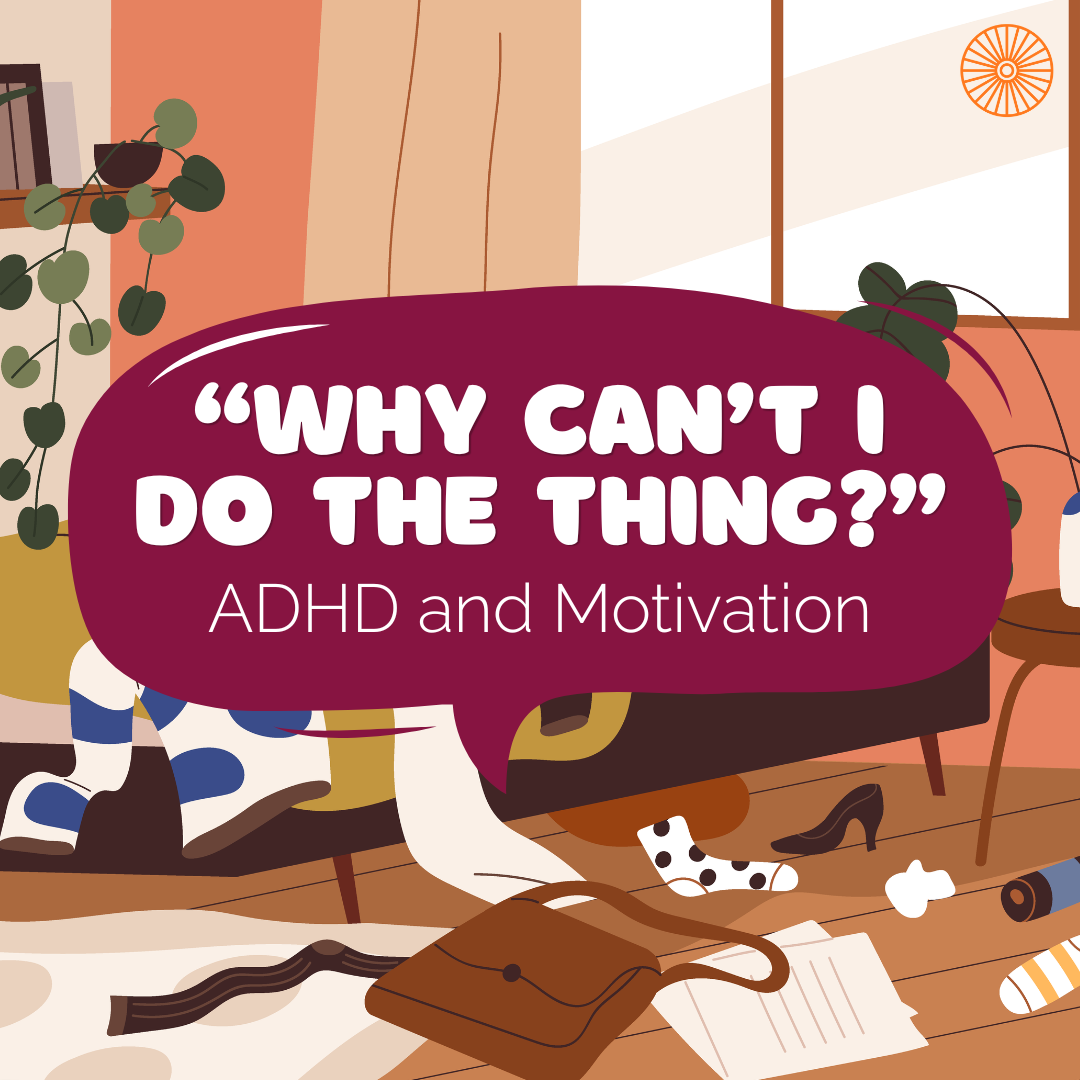
“Why Can’t I Do The Thing?” ADHD and Motivation
Written by Stephanie Scheller, Producer & Author
One of my favorite hobbies is writing fantasy stories. It’s the one hobby that has stuck from junior high through my first corporate job and subsequently more than a decade of entrepreneurship. I love writing, my fantasy world, and my characters. I enjoy losing myself in the intricacies.
And I know the science of body doubling, and a myriad of ways to spark hyperfocus.
And I still hit a wall where, for several years, I struggled to progress in this thing I loved.
When this happened, I was advised to reconnect with my Why in writing. Because the universally accepted answer to not doing the thing I wanted to do was that I lacked motivation.
Throughout my life, as someone who did not find out she had ADHD till mid-twenties, there have been many times when I’ve wondered what’s wrong with me. Particularly when I’ve had a task that I am excited for – like writing on my novels – that I cannot seem to even start.
Eventually, I realized that nothing was wrong with me, and I didn’t love writing any less. It’s just that my brain will regularly look at a task, understand the task, agree that the task matters…Then, decide that we are not doing that today.
For years, I blamed motivation. I blamed discipline. I blamed character flaws. I thought the answer lay in joining the 5 AM Club, or the Ice Water Bath Crew, or the Weekend Meal Preppers. Turns out, while none of those are inherently bad, none of them were the issue either. As the lovely clinician who alerted me to my diagnoses told me, “You’re so ADHD, you are the test, Stephanie!”
Contrary to popular belief, I’ve learned that as an ADHD-er, when I’m struggling to complete a task, it’s rarely about motivation. It’s never about being lazy.
It’s about understanding how my brain works.
That’s the part that gets missed when we reduce advice for ADHD-ers to “just try harder!”
And when I understand how my brain works, there are two tools I can use to spark and maintain momentum without burning out.
It’s an Operating System Issue, Not a Character Issue
A few years back, I was on a call with a client, trying to walk her through how to do something on her computer. Frustration mounted for both parties as the exact steps I took on my computer did not work on hers. Repeatedly. Finally, she asked if she should look this up in Safari instead of Chrome. Cue the cartoon lightbulb moment as I asked if she was on a Mac instead of a PC. Looking up instructions for a Mac eliminated both of our frustrations.
In terms of my brain, I spent most of my life looking up instructions for a neuronormal operating system when I’m running the ADHD operating system. No wonder I’ve ended up frustrated more than not.
As it turns out, the analogy is apt in more ways than one. The ADHD internal operation system and the Neuronormal internal operating system don’t just have different strengths and weaknesses, just like an Apple device and a PC or Android; science has shown us repeatedly that they are physically different too.
There’s a reason you can’t use a lightning port to charge your Android.
And it doesn’t mean that either the cord or the device is defective.
Yet most advice that we receive assumes we’re functioning like a neuronormal brain.
- “Make a plan and follow it” is based on assuming the brain has typical executive functioning capabilities and can reliably access the plan when needed.
- “Think about the consequences” relies on future consequences, creating present-moment activation, which relies on a clear grasp of time.
- “Do the important thing first” requires “important” to be what activates the brain most.
You already know that’s not how your brain works.
Importance matters. Consequences matter. Plans matter. But they don’t always translate to action and productivity. In varying quantities at different times, my brain requires interest, urgency, novelty, emotional safety, visible momentum, external structures, movement, and clear entry points before the system boots up.
And that’s not a metaphor. ADHD brains have neurological differences in executive function, which includes the brain’s ability to activate, organize, prioritize, regulate, and follow through. We rarely need more pressure. Usually, we need a better entry point.
This is why “just try harder” is so damaging. It’s pointing at an effort issue and turns access into a character trial. If the door is locked, yelling at yourself to walk through it does not make you more disciplined. It just makes you tired and ashamed while still standing outside the door.
What Actually Helps
If I had a magical potion to make motivation consistent, I’d have bought it, color-coded it, given it a dramatic name, and probably created a theme song. It took me years to learn that there’s a lot going on neurologically for the ADHD brain, but rather than fixating just on what’s happening, though, I’ve learned to lean on two tools:
- Give myself grace. We’ll talk about this more in a moment, but sometimes, now is not the time for the big thing.
- Create better access points for my brain.
Let’s be fair. Sometimes, allowing ourselves to push things down the road is a bad idea. Filing taxes. Getting the AC fixed if it’s June and you live in Texas. That proposal that’s needed at work to win the big account.
There are some things that you can’t just keep pushing.
So, I’ve learned to create better access points for my brain. When I’m avoiding a task, starting with asking myself curiosity-led questions makes a big difference.
Things like:
- Is the first step actually clear or am I combining too many steps into one?
- Is the task boring, emotionally loaded, or too big to touch?
- Am I regulated enough to start?
In a classic example of how the first one has served me, at time of writing, I’ve had a project on my calendar for three weeks now that I’ve rescheduled a minimum of six times. Today, I realized “Send First Outreach” to this group of people was too disconnected. There are multiple steps between where I stand today and sending that first outreach. I need to verify the spreadsheet my team put together for me is properly formatted and review each person on the sheet to ensure they’re the right fit. Then I need to come up with the topic for the first outreach and write it. Then edit it. Resetting my calendar item to “Review Spreadsheet Formatting” took a load off my chest that I didn’t even know was there.
Since ADHD brains can struggle with the non-tangible, just breaking down a larger task into smaller steps can help our brains visualize them better.
In one of my favorite examples, sometimes it’s not about skipping steps; sometimes it’s about connecting with a reason that matters to you. One of the most counterintuitive pieces of advice I ever received was, “Give yourself the Oreo first.”
As background, we’d just bought tiramisu Oreos. As an Italian, I was in! I promised myself that I could have one Oreo for each drawer I organized in our front room – a task I’d long been avoiding. Except, you can guess where this goes. The Oreos sat on the counter, taunting me, and the drawers remained unorganized.
By the next weekend, I was about to rip into the Oreos and just admit the bribe had been a failure. I don’t remember who I was talking to, but they laughed and told me to just give myself the Oreo first. I do remember thinking that was the stupidest thing I’d ever heard as I broke into the Oreo and enjoyed that crunchy, chocolatey, creamy, coffee-y goodness.
Somewhere between putting the cookie in my mouth and making absolutely inappropriate noises at the flavors a realization hit: I’d promised myself this was a reward for organizing the drawers. And I have been trying so hard to be better about keeping promises to myself. With that in mind, I decided that I could organize the small drawer real quick.
An hour or so later, the entire front room was organized, and I was sitting down with a few more cookies and a cup of milk.
Let’s be fair, the sugar probably helped with the dopamine dysregulation inherent to ADHD brains, but I believe there are two reasons this has worked so well for me so many times since.
First, future rewards are hard for the ADHD brain to really grasp because time is not easy for our brains to grasp.
Secondarily, I found something that mattered to me in the midst of a task that didn’t. Ultimately, the drawers were out of sight, out of mind – a classic ADHD conundrum. But this fixation on not compromising my word to myself had become something tied to the core of myself.
There have been countless instances in both my writing and my businesses where I’ve discovered that the reason I’m staring at a blank page is because I haven’t done enough planning. I’m missing information. Or I’m trying to force something that doesn’t work, and the pressure is mounting.
And while pressure often works well for the ADHD brain, research suggests it creates diminishing returns when leaned on too heavily — and sometimes it backfires in the worst ways possible. In Summer 2025, I discovered this in the most spectacular way possible. My fantasy writing had been proceeding at a furious pace. Everything was going well. Feedback from beta readers started arriving, and I started to realize that… this thing could be big.
Cue the freeze.
For weeks, I sat staring at my laptop on lunch breaks and evenings. I wrote scene after scene, deleting each one as too clumsy, too out of character, too cliche, etc. Finally, frustrated and trying to take the pressure off, I challenged myself to write the worst, trope-filled story I could. I created a list of all the tropes to include. Made up hilariously bad characters (Brooke for a book-lover and Alex for an alpha-male presenting character). At the end of the week, I had a solid novella that my beta readers cried over, and I was champing at the bit to return to my larger arcs.
I’ve used body doubling with best friends that I never get to spend time with to make it more exciting to start. I’ve renamed “chores” to “resetting the stage.” I’ve sat on the floor with giant markers and a pad of paper to scrawl out, “Why can’t I make myself do the thing?” only to find the answer flowing from my hand a few minutes later as I keep writing, giving myself something I can actually address.
In many instances, looking for the wall before defaulting to calling myself lazy, or “not good enough,” takes me a lot further. Maybe I’m missing information. Maybe the task is too big, and my brain can’t find the door. Maybe it’s a decision I don’t want to make because there’s a person I don’t want to disappoint or a sensory issue I’ve been pretending isn’t draining me.
When I can find what is actually making this feel insurmountable, I can deal with it so I can keep myself moving forward overall.
Sometimes I Do Not Need Motivation. I Need Regulation.
I was in my thirties before I realized that sometimes the wall isn’t about the task at all. A few evenings ago, I gave up on trying to force myself to write and texted my best friend, “I’m itchy tonight…”
Seconds later, her reply came, “I hate those. I always end up pacing. [Husband’s name] used to look at me like I was crazy!”
It’s not that I’d rolled in a patch of poison ivy or gotten eaten alive by mosquitos. I wasn’t literally itchy. That was simply the best description my overloaded nervous system could find for how I felt all over. And when the nervous system gets overloaded, everything gets harder. Starting. Thinking. Choosing.
Tasks I enjoy suddenly feel like climbing a mountain wearing a backpack full of wet cement.
For years, I pushed through. I thought that was what responsible people did. I thought that everyone was dealing with this; they were just better than I was.
I thought if I worked hard, I’d earn a rested feeling. So, I would finish the work. Answer the emails. Get the task done.
It took me longer than I’d like to admit to realize that, for my ADHD brain, regulation is not the reward at the end. It’s how I access the beginning.
Remember the part where I said that sometimes I need to give myself grace?
This is that moment.
Sometimes I do need to push the thing.
First, I need to move, get food, water, music, quiet, or curl up under the weighted blanket and set a 20-min timer.
And when I get up, sometimes I still can’t do the thing that day. This is where I’ve learned to start things earlier than I think I will need to, so that if I need to, I can push the thing to tomorrow. I can take a minute to ask questions and identify a better access point for myself.
I can have grace for myself without causing shame.
Because living with ADHD isn’t about being crippled or having some secret superpower that everyone else has figured out how to master and you haven’t.
Living with ADHD is about learning to listen to myself, to give myself the reins when I’m blowing and going, and support myself when I’m not. That has been the key to all of my writing (four self-help books and five novels with another eight on the horizon). That has been how I’ve stuck with the violin, a notoriously challenging instrument, almost daily for seven years. That’s how I came up with the concept of our adventure kits.
I’ve had many people look at me and tell me that there’s no way I’m ADHD.
Truth is, when we listen to and care for ourselves, we can accomplish incredible things.

Stephanie Scheller creates the things that she needed as an ADHD entrepreneur to help others like her grow their businesses too. A TEDx speaker, three-time bestselling author, and award-winning entrepreneur, Stephanie is a classic ADHD-er who writes, speaks, and creates tools for brains that do not always fit traditional systems. Learn more about Stephanie at GrowDisrupt.com.